Sunday, December 2, 2012

Pushkar Camel Fair

Camel and cart

When I first heard about the Pushkar Camel Fair from a student last year, I knew it was a must-see. I was right! This year the full-moon in November (necessary for this festival) landed on our 4-day Thanksgiving break. So dozens of AES teachers and families booked their train tickets in the summer for this outrageous celebration.


Camel and horse traders come from all over the desert to sell, race and decorate their livestock. There were over 20,000 camels at the fair. My favorite time was roaming amongst the camels and herders at sunset and early morning (well, not that early). I had always been told that camels can be rather nasty; spitting, biting and head butting. I found them to be quite gentle, unless spooked. I walked in and around the camels never feeling afraid. The nomads tending their animals were equally friendly.

Horse trader
Boy riding camel through the streets
Besides coming to sell and trade livestock, the traders from all over Rajasthan participated in camel races, camel and horse dancing, decorating, etc. The carnival-like atmosphere is so colorful that all I wanted to do was to sit and take pictures. Which is exactly what many professional photgraphers do, coming from all over the world for this spectacle. 

Woman selling blankets.
Young girls selling cook ware.


Dancing horse
The first days of the fair are mostly centered around the animals. The second part is for a pilgrimage to the holy waters of Pushkar Lake, where thousands and thousands of people come to do pujas (prayers) and bathe in the lake. Pushkar is in the top five places for pilgrimage by Hindus.

Tight-rope dancing girl
Some of the sideshows were quite amazing, but wreaking of "child labor". Still, I couldn't keep my eyes from watching. 

Woman collecting camel dung
The women and children (girls) rolled the cow dung by hand into little balls. Then the women carried them in large bowls on their heads to a place to make patties to dry for fuel. This woman smiled the whole time.

Doing laundry
As I walked through the narrow alleys of the town, a simple life of daily routines evolved. Several members of a family live in these one-room brick huts, cooking and cleaning on the sidewalks. Most were very willing for me to take photos and few asked for money.

Necklaces anyone?
There were hawkers everywhere who were very persistent. My friend, Kris, decided to buy some of these necklaces to take home to resell at a local shop. After buying 20  or so, she thought they would leave her alone. Nope. Every time they saw her they followed and followed and followed...

Kris with newly purchased necklaces. 

Eager to be photographed
I always ask (usually) if I can take someone's picture. Most say yes as long as they can see the picture immediately afterwards. They grin and laugh when seeing themselves.

"Spotted" horse
I cracked up when I saw this painted "spotted" horse.

Pointed-ear pony
View from my roof-top hotel room
We stayed in the Everest Hotel, a delightful and colorful small hotel near the center of town. Very clean, roof-top restaurant, and friendly young staff. Loved waking up to the sounds of of kids flying kites. However, the monkeys liked hanging out on my terrace too.

Holy men arriving for the religious celebration
Our last day in Pushkar was transformed into saffron-colored streams of worshipers. The streets were impassable, so I plunked myself down in the camel stadium and shot away. I would definitely get to the fair in the first part of the week. 

Me and my guy
The Pushkar Camel Fair is a must-see experience in India. It makes me want to wander further west into the desert...

How I felt at the end!

Saturday, November 17, 2012

Kerala

Typical fishing "kayak"

Another 4-day break in celebration of Diwali, the Festival of Lights. So off four of us flew to the southern most tip of India to beautiful tropical Kerala on the Arabian Sea. In many ways it felt like parts of Central America.

Chinese fishing nets that go up and down all day.
Picking out our fish for dinner.
Our first night we spent in Ft. Cochin, an old British settlement. Our hotel was a cheap but moldy smelling place. Staff was plenty friendly and it was in a great location, but you get what you pay for!

The next day we hired a driver to take us to the launching place of our houseboat in the backwaters.

Wooden hulled with hand-woven thatched roofs.

Our captains
The men of Kerala all wear cotton mundus, or"skirts", usually orange, but also of many other colors. During the heat of the day, they roll them up into a pair of shorts. Nope, nothing underneath!

Getting ready to sail with Holli, Rick and Kris
Paddling to work?
Morning bathing


Man in mundu cutting bamboo
 

For the next 24 hours we cruised along channel after channel watching this amazing life go by. Our boat was equipped with running water (probably from the lake), a real toilet (undoubtedly flushes into the lake), AC, and fully prepared delicious meals. The houseboat/backwater business is quite thriving. We were surprised to learn that there are over 2,000 of these boats that are used for tourism.  So, although we lazily relaxed, we were not the only houseboat on the lake!

Prawns anyone?
We stopped at this fish market to pick out our dinner. Our captain told us of an Ayurveda massage center just up the spit from the fish market. The captain said, "My father owns it." I have come to learn that everyone is "family" in India and it is a way of marketing. Anyway, Holli and I decided to check it out. What a delight. I got my first ever fruit massage! I like to try things that I have not done before so why not? In came a bowl of freshly pureed bananas, pomegranate, and watermelon.  It was like a soft scrub massage and full-body mask. All naked, without a sheet or towel! After my hour massage, I was hand bathed and shampooed. (The water was pretty brown...lake water?). So $28 later I felt renewed.

Spice jars

The next day we left for two days at the beach. Along the way we saw many roadside stands selling birdhouses, hammocks, and spice jars. Kerala is the land of spices,where many spices are grown and exported. There are also rice paddies, tapioca and pineapple farms.
  
Devi, a Hindu goddess, along the road. She scares away evil. You think?


Kris and Rick at Indriya Resort

The next two days we spent swimming in a luxurious pool and taking long walks on Cherai Beach at a lovely resort called Indriya. It is a brand new 5-star hotel that is trying to figure out how to cater to westerners. For instance, Kris and Rick called to order some food from the room-service menu. "Sorry room service is not available". Then we tried to eat at their seafood restaurant, "Sorry, that restaurant is not open today". Oh, well, after the smog and pollution in Delhi we were thrilled to be in blue skies and clean water.

One of my favorite sayings from this trip is when one of the workers said, "Many confusings". Fits India to a tee!

Joyous people everywhere

Kerala is the home to a balance of Christians, Muslims, and Hindus. They accept each others' way of life and religion. On the night of Diwali (a Hindu celebration), it seemed like the whole town came down to the beach. It was quite a sight to see nuns in full habits tiptoeing through the waves, Muslim women in birkas swimming up to their waists, and women dressed in saris taking a dip.

Cool local boys
Stunning young woman
Stunning older woman
A most interesting part of Kerala is that it is a socialist state in India. People are very friendly and happy. No beggars or children selling trinkets. Kerala also has the highest literacy rate in India (93%)! While people are poor by our standards, they seem to have their basic needs met and are grateful. 

Next trip to Kerala...the hill countries.

Sunday, October 14, 2012

Rishikesh Part III: The Beatles' Ashram

In 1968 the Beatles traveled to Rishikesh with wives, girlfriends, assistants and reporters to study Transcendental Meditation with the guru Maharishi Mahesh Yogi. They joined Donovan, Mike Love, Paul Horn, Mia Farrow, and her sister, Prudence (remember the song Dear Prudence?).

I was determined to find the ashram, having been and still am, an avid Beatles fan. A report from my friend, Kathy, said that it was quite overgrown and abandoned. So the first day in Rishikesh I dragged my young friends, Cristi and Shannon, in search of this lost treasure. Our hotel manager said , "Go over the bridge and then it's about a 20 minute walk."


Two hours later, fighting hordes of Ganges worshipers, cows, honking motorcycles and persistent hawkers, we finally ran into this sign, the one and only sign pointing in a general direction towards the ashram. Another twenty minutes and the road dead-ended on the river. Was this the ashram that we heard so much about?

A park-like piece of land next to the river was overtaken by several sadhus, bathing, washing their robes, and smoking who knows what? Somehow this didn't feel like the place, but we had come to the end of the road.
Shannon checks out one of the sadhu's' homes. He did have the best view in the world.

So, we left knowing that somehow we had missed a turn somewhere. Sure enough, on our last day in Rishikesh we set off again in search of the mysterious ashram. This time we decided to ask an American-looking couple and they pointed us up a dried-up creek bed, not far from where we were the first time.

I was, and still am, amazed that there was no sign, no selling tacky Beatles key chains and t-shirts. Instead, behind an iron gate with a simple padlock sat this man waiting to charge us whatever he could get out of us to open the gate. He was camped out in one of the abandoned buildings. We happily paid 100rs each ($2) and were told we would have a guide. Ha! Not a soul in sight.

Meditation caves


Inside "Number 9"
The next two hours was truly surreal. We had the whole 14 acres to ourselves, except for a one-legged sadhu using a scythe to hack away at some of the tangled weeds.

Sadhu hacking away at the weeds with a great smile.
I thought for sure he would hit us up for more money. Instead he tried to tell us stories in the little English he knew about finding cobras with double fangs, seeing a huge leopard, and wild elephants on the land. Great...

Cristi negotiating with the enormous spiders.

Imagine...


The Beatles wrote over 48 songs during their short two-month stay. Several of the songs appear on the White Album and two on Abbey Road. Ringo left after only a few days due to an illness, then Paul. John and George stayed the longest, but left when a riff happened over the Mararishi  using their fame to collect more money. Coming to Rishikesh, however, put India on the map and made yoga/meditation a worldly focus.

As I was ambling up the path, keeping my eyes out for those giant snakes and tigers, I stumbled upon a rickety old building that looked like it was used for group gatherings. To my surprise, it was full of recent paintings by artists/song writers who camped out illegally for two weeks in April 2012.
 
The following photos of are of the artwork of a few dozen artists. For more info go to The Beatles Cathedral/Gallery.com


The "art fest" lasted for just two two weeks before being shut down. Satsang Hall is in a shambles, with the roof caving in. I can't help but wonder why this memorable place has not been preserved.

I was a happy camper to have found the actual ashram, and to be able to freely roam, just the three of us. Trying to imagine the scene of such great artists and healers gathering together. Incredible India!


Saturday, October 6, 2012

Rishikesh Part II


The Ganges
Sometimes I have to pinch myself to remember what a gift it is to spend time in these most sacred places. 

For day two we decided to venture off on a little hike "down the road" and up a trail to find a waterfall. Whenever you ask directions in India, people simply say something like,"Just a ten minute walk", or "Just around the corner". So the three of us set off on foot on the mountain road in search of the waterfall trail. In distance, the walk was not THAT far, but the winding corners and signs like these tell it all. On our way back, some nice young men offered us a ride and we took it!

Shannon ready for a dip
We made it to the first of the falls but found the trail too washed out by earlier flooding to go any further. So we spent the afternoon soaking in the pools and basking in the fresh mountain air. Such a treat after Delhi!


This is no joke!
As we headed back into town and to a cafe for lunch, this man came up behind us trying to sell his services of an ear cleaning. He kept saying, "Let me just show you how I work." Any service can be had just about anytime. Notice the cotton balls he has tucked behind his ears. I was trying so hard not to laugh, I finally asked him if I could take his picture. He agreed with a smile but wanted to see the photo. He smiled even bigger.

Monkey on suspension bridge
Next post: The Beatles's Ashram!

Friday, October 5, 2012

Rishikesh Part I

Shiva on the Ganges River

We have several three and four-day holidays in our school year. It's a great time to explore places that I have not yet visited. So, off we went to explore Rishikesh, the "Gateway to the Himalayas" and the "World Capital of Yoga". A short 45 minute flight north from Delhi, then an hour drive brought us to a deeply spiritual place for Hindus.

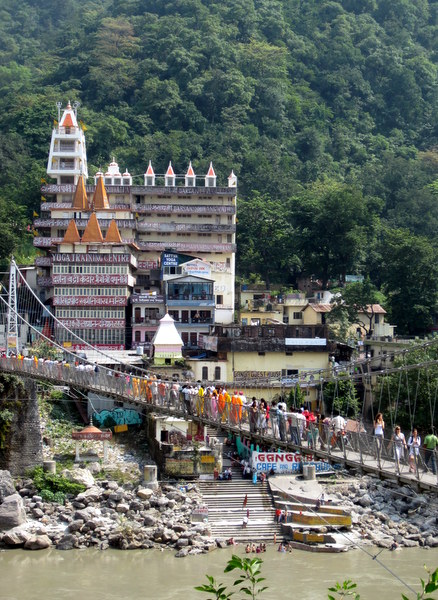
Laxman Jhule suspension bridge across the Ganges
Our little hotel was just up a dirt path from this suspension bridge leading into the heart of Rishikesh. Thousands of Hindus make pilgrimages to Rishikesh to meditate and bathe in the holy Ganges River. Unlike in Varanasi, this part of the river is quite clean, just flowing out of the mountains. River rafting is also a huge draw to this region.

If you look very closely you will see a cow or two on the bridge. They have the right of way!

Simple, clean and cheap!
This hotel was a great find. Freshly made Indian food made on request, and a yoga teacher and massage therapist came daily just for us.

Cristi and Shannon on the roof-top
French press coffee!! Now that is a treat in India. Rishikesh is a place that many westerners come to be trained as yoga and meditation teachers. There was a yoga/meditation/aruyvedic center on every corner. Nothing like at home, however. Most were holes-in-the wall with tangled electrical wires dangling and cow poop on the sidewalks.

Typical yoga "studio"
Hindu temple across the bridge
Cristi and I ventured to the temple one day. Five plus stories of shrines, each with different Hindu deities. Hundreds of different gods! Worshipers would ring a bell when entering the shrine, usually touch part of the god, or leave an offering. Cristi and I decided we really needed to do more studying about Hinduism. Very complex.

The Ganga Aarti
Our first night we joined hundreds of people for the nightly ritual called the Aarti. An aarti is a type of puja, or religious offering to a deity. Singing and lighting of lanterns begin at dusk. The ceremony is in a spirit of humility and gratitude.

Receiving a blessing of light
Meditating
Sadhu
Sadhus are everywhere in Rishikesh. In Hindu, they are considered holy men (and women) who wander in pursuit of moksha (attainment of liberation from the cycle of rebirth)). Sadhus leave behind all material and sexual attachments. They often wear ochre-colored clothing symbolizing sanyasa (renunciation). They usually live in temples, caves and forests. Many sadhus awake at the wee hours of the morning to come to the river to meditate and bathe. During the day, the sadhus were seen sleeping under trees and along alleys.

It is often challenging/impossible to distinguish between true sadhus and street beggars, or drop-out travelers. It is thought that there are 4-5 million sadhus in India and Nepal. 

Sadhus or beggars?