Monday, February 13, 2012

Gond Artists

This week a visiting artist, Sunil Kumar Dhurvey from a tribal village in central India, taught the fifth graders the history and techniques of Gond Art. Traditionally this form of art was painted on the exterior of buildings by the women. So many people from around the world loved the artwork, that artists like Sunil and his family began painting on paper and canvas to sell.

Sunil demonstrated how the paints were originally made from plants and flowers.Today he uses acrylic paints and special "dot" pens.

First an outline of an animal or plant is drawn, then painted with solid acrylic paints. I was amazed at how both Sunil and his wife simply sat on the floor or on a short stool to do their work.

Sunil added fine dot and scallop details with his pens. This tiger painting was inspired by masked dancers at a traditional wedding party in his village. I purchased this piece, along with 3 others, for 500 Rs each ($10 each!).


Another favorite


It is curious how similar the style of art is amongst native people in places like Mexico and Australia.

Sunil's wife was adorned right down to the toes! It was a pleasure to spend time with these humble artists, whose craft has spanned generations.


Saturday, February 4, 2012

Ranthambhore National Park with 120 Fifth Graders!

At 6:30 A.M. on Wednesday, 120 fifth graders and over 30 adults boarded two sleeper coaches for Ranthambhore National Park, which is located in Rajesthan nearly 450 km southwest of Delhi. Getting safely onto the train amidst thousands of milling travelers at this wee hour in the morning was quite challenging. Although you can get most anywhere by train in India, the lack of infrastructure, including sidewalks, signage, and other usable facilities (toilets) makes traveling by train difficult at best.

We traveled for nearly six hours through rural India. I wonder if I will ever stop being amazed by the women working in the fields clothed in shimmering sarees, squatting and digging with their hands. Camels pull carts carrying everything from bricks to crates of guavas. Men using bare feet to stand on wooden handles to start a pump. Green fields all planted, looking very over worked.

Group of women catching a ride on a camel cart.
Once we arrived in the town of Ranthambhore, we were greeted by a squad of cantor drivers and guides to take us to our hotels.

There was very little down time before we jumped onto our designated cantors and were off for a hike through the 1,000 year old remains of the Ranthambhore Fort. The history of this fort is still not clear, but it certainly was the home of mighty kings and warring factions. Eventually it became the hunting grounds for the King of Jaipur. Royals from all over the world, including Queen Elizabeth II, came here to "bag" a tiger or leopard until it was finally ended in 1970.


One of the entry gates into the fort.                                    
Another entry point. Stones were thrown at this figure (forgot who) before entering.

Langur monkeys are over-running the fort.
View from the fort. Tiger habitat!


A holy man coming down from the Wednesday pilgrimage to the Ganesh Temple.
Day II:  Awoke and boarded the cantors for our first game drive in the park. Each cantor is given a specific zone to be in so that one area is not over crowded. Our group drew Zone 4, a rugged terrain through hills and riverbeds. Our guard almost immediately spotted fresh tiger marks.

Tiger tracks


We saw several species of birds, huge 8-10 ft crocodiles, several Sambar deer (tiger's favorite), antelope, but no tiger. I was quite content at the time we spent in the forest until we returned to our hotel to learn that three of the cantors had spotted 2-3 tigers! This was quite amazing as there are only about 40 tigers left in the park. More on that later...

Sambar deer. The tiger's favorite meal.
Reflection of two kingfishers in croc lake.
Each student chose an afternoon activity from visiting a village, time with a local artist, birdwatching, etc. My group went to an organic farm using solar energy and a methane conversion process. It was a lovely, simple reprieve from the excitement  of travel and being on a safari. While what I saw was not revolutionary by American standards, it was one of the first farms of its kind in Rajesthan. We all came away with organic guavas, cucumbers and beautiful flowers.


A giant banyan tree creating an arch into the park.

Safari Number II: A quick lunch and then back onto the cantors for another game drive into the park. There are only two times/day for the park permits; early morning and late afternoon/early evening. This time we were given Zone 2 where a young female tiger was spotted in the morning. Again, I told the kids that we would be searching for other park species and not to count on seeing a tiger. I have heard that many many people come from all over the world and never see a tiger here. 

We lucked out and drew the best park guide available. Himmat knows the park inside and out and can talk in depth about every species of plant and animal. He has been researching animal and plant life in the park for many years. Just having him as our guide was rewarding enough. Along the way we saw wild boar, serpent eagles, owls, leopard tracks, but no tiger. 

Wild boar

Pond heron
Owl
By this time the kids and I were a little ragged, cold and hungry. We knew another day was just about over. The guide told the driver to turn back. Just as we were turning the last corner out of the park our guide noticed several cantors waving us over. There in the bush was a very frightened Sambar deer, frozen in panic. A tiger was sure to be near. We waited and waited and waited. Then there she was right in front of our cantor!!

T-17 stalking the Sambar oblivious to our presence.    

 
The feeling of seeing this magnificent creature brought me to tears. There are so few left in the wild.
That day all 120 students saw a tiger! 
 
Day III: Up bright and early again at the crack of dawn for one last game drive. When we got to our cantor I was given a choice of going to Zone 3, the lake region, or Zone 6, a more rugged trip. I opted for the  lakes, as I personally wanted an easier trip just to enjoy the last day. Afterall, we had seen a tiger and were quite satisfied. 
 
We hadn't even been out for 30 minutes when another guide shared a sighting. Quickly our driver turned around and headed to a lovely open meadow. There she was again, T-17, basking in the early morning light. This time we were able to just sit and watch her yawn, stretch and amble up for the day's hunt. We were the only school cantor there and were feeling mighty proud. 
T-17 enjoying the morning   
T-17 heading into the wetlands
The guides on all 5 cantors gave her plenty of space but followed her for over an hour. She disappeared into the marshy bush, and later appeared wading a lake toward an island refuge. The langurs and birds squawked to warn the other creatures along her path. It was a remarkable morning and my thoughts about how many of these tigers are killed through poaching (for their skins and parts for Chinese medicine), and poisoned by farmers makes my head spin. Even our intrusion into their habitat makes me uncomfortable. However, through the education of Project Tiger, perhaps today's kids can do much more to protect them. 


Our guide, Himmat Shekhawat, and Indian Studies teacher at AES, Hema Meira.
It's people like Himmat and Hema, who passionately work for Project Tiger, that hopefully my grandson, Gage, will be able to come to India to see the tigers.


Thursday, January 26, 2012

Education as the Way

There have been several strong messages this past week from some very powerful people in the world. Anyone who comes to India is awestruck by the dire poverty and disease contrasted with the emerging modernization. When toddlers weave in and out of rush-hour traffic, barefooted with matted lice-covered hair begging, and old men sleeping in near freezing conditions wrapped only in a blanket on concrete, you have to wonder...what is the answer?

Oprah made a visit to Jaipur, India this past week for a literary conference. I watched several interviews with her on television. As she so simply put it, "The only thing that will make a difference is education for all."

Last night I had the pleasure to hear Dr. Robert Thurman speak at the Indian Cultural Center.

Dr. Thurman (father of actress Uma Thurman, who went to AES) is an American scholar of Buddhism at Columbia University. He is author of several books about Buddhism and one of the founders (with Richard Gere) of Tibet House in NY, which promotes the preservation of the Tibetan culture.

Education was also one of Dr. Thurman's main points last night. In the past decade researchers have discovered that our brain continually regenerates new brain neurons. So learning something new everyday, all throughout life, is the key to keeping our brain cells from dying. He went on to explain that Buddha (and I believe Christ) were not about "religions" but about teaching how to live one's life. Meditation, he explained, is NOT about emptying one's mind, but digging deeper into our souls to touch the commonality between all human beings.

One of my students, Janya, recently wrote an eloquent essay about the importance of education for girls in India.

Janya getting ready to sing the Indian National Anthem at the Republic Day assembly.

In her essay, Janya explained how in India if there is a choice to send a boy or a girl to school, most traditional families will send the boy for monetary reasons. She then documented the lives of a handful of successful India women. The difference...education. Nicely done, Janya!
 
And finally this week, a great friend who I haven't seen in 20 years, found me recently on Facebook. Linda passed along this quote:

"My continuing passion is to part a curtain, that invisible veil of indifference that fills between us and that blinds us to each others presence, each others wonder, each others human plight." by Eudora Welty

I am a teacher and I am proud to be one!


Tuesday, January 24, 2012

Art at AES

 by Maya/ Third Grade

One of the many attributes of AES that keeps me smiling is the artwork that adorns every hallway. All students, K-12, receive specialized art classes (and music and drama). Sadly, I don't get to do as much art in my own classroom because there just isn't enough time in their busy schedules. So, I enjoy cruising the hallways each week in search of new work.

This series of oil pastels is based on traditional Indian artwork called the Gond Style. Gond artists create images that are stylized and highly decorated with patterns and designs.

by Kevin/Third Grader


Just around the corner was a small exhibit of animal sculptures by middle schoolers.


More to come!


Friday, January 13, 2012

A Village School

On our way to Dharmasala over Thanksgiving weekend, our curiosity was peaked when we viewed a handful of small village schools. The students were all outdoors, in neat rows, performing some possible rituals or praying or? As we approached a school, we asked our driver to please stop. I jumped out of the van (in clear need of a break from the winding mountain roads) and peeked inside the walled school. I decided that I would enter the school and hope that I could gain entry.

I waited a few moments before walking toward the school. Certainly I did not want to be disruptive nor break a safety/security rule. A woman approached so I walked forward. I immediately introduced myself as a teacher from the American Embassy school in Delhi. Instantly I was treated like royalty again. My friends Shannon and Karen then came around the fence to join me (chickens!). 

The head mistress was more than willing to give us a tour of the school. Those neat rows of students outside were actually students  doing schoolwork. They sat cross-legged in dirt or concrete, eyes locked on their teacher, not daring to smile or giggle at us. When we approached, they stood in respect. All the children were impeccably dressed in spotless uniforms.The girls' hair was braided with ribbons and bows. Not a speck of dirt.I imagine that most of these students live in dwellings with no plumbing and running water.


This class was using a protractor and a pencil to draw finely angled geometric shapes. I assumed they were doing math but the head mistress explained that they were in an art class.


Then she told this beautiful girl to go get her notebook. Ah, yes!

We then were taken "inside" where we discovered barren rooms with no desks, chairs,or books. Just a wood stove in the corner for winter time. In the kitchen was a huge pot sitting on a hotplate for making lunch of rice and curried lentils. We were immediately given water, which we pretended to sip, as most water systems are hardly filtered. The head mistress insisted we sit for tea, but four of our friends were waiting outside the gate for us anxious to complete our journey to Dharmasala.

So we said our goodbyes (several times) after signing their guest book. Back at AES a controversy is in place about whether every student should have their own iPad and/or laptop. Here a new pointed pencil is a gift. Sadly, I did not get the name of the school to send a thank you. So, I'm sending it through all of you!


Saturday, December 10, 2011

My First Indian Wedding


Some of the first people that many of the Newbies at AES met upon our arrival in Delhi were our drivers for the first two weeks. Maxwell happened to be my driver and I got to know him well. A most gracious and caring man, Max promised that if there was a wedding in his family he would invite some of us. So when the invitation came for his sister's daughter's wedding I was overjoyed.

Maxwell and his father at the wedding.

Indian weddings can typically go on for three days. This wedding was unusual because the couple was being married in a Catholic church, but they were still celebrating in a traditional Indian way.

Two nights before the wedding, the bride is adorned with turmeric and sandalwood by the women on her side of the family. Her simple muslin saree (sari) is also rubbed with the mixture, as well as her hair.  Gifts of food and flowers are placed around her.


The second night for the bride is the mehndi (henna tattooing) ceremony. The bride and her closest family friends and relatives are painted in intricate henna designs. The bride has both her arms and legs adorned. It took three hours for her mehndi to be finished, then hours of drying and chafing off the extra henna. A mixture of lemon juice and oil are dabbed over the henna to enhance the penetration.


As the bride patiently sits through this process, her brothers, uncles, aunts,sisters, and mother sing and dance for her. In fact, we all danced. She cried throughout the process because this would be the last days together with her side of the family.

In the corner a woman sat cutting vegetables and making a pot of curried vegees for the guests.

Then it was my turn to receive the mehndi. The lovely young women who did my hands (not feet), had a sweet daughter who sat quietly throughout the whole procedure. 

Nancy, my team teaching partner, and I kept shaking our heads at the wonder of it all. We were instantly made a part of the family and were treated like royalty for the next two days.

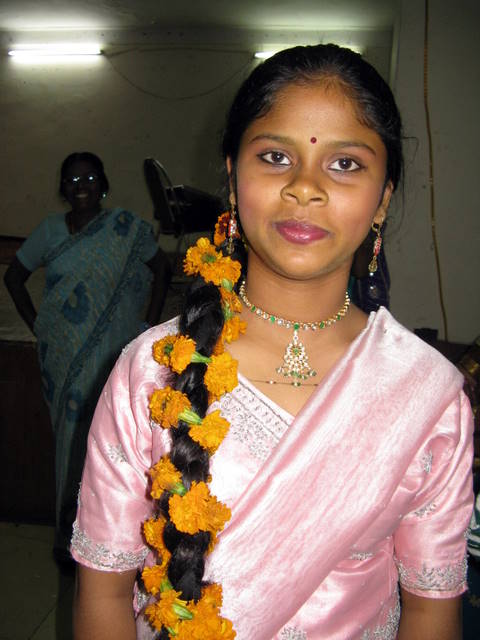
The young girls had marigolds woven into their braids for the mehndi ceremony. Prospective brides?


The next day a bathing process occurs for the bride to prepare her for the actual wedding day.  No, we were not part of this very private and special time for the bride to spend time with her mother and closest female family members for the last time. Once she is married, she will move in with the groom's family and say goodbye to her family.

Nancy, Katrina (another teacher from AES), and I set out about 6 pm for the wedding. Selecting and having our sarees made was quite a process. That's another story for another time! However, how do you put on a saree? Thankfully, Nancy's wonderful housekeeper was more than willing to drape and pin us. 


We were unable to attend the actual church service as we had to teach. But we arrived in time for the cake cutting, gift giving and dinner. Well, part of it anyway. There were over 600 guests coming and going all throughout the evening. Plenty of dancing and eating.
Upon our arrival, Max greeted us and sat us in the front row, in front of his family!! This type of treatment in India continues to overwhelm me. Teachers are so valued and honored. Plus being Americans, we are revered.  I am continually humbled. Max's family greeted us with hugs and kisses as if we had been part of their family forever. And lots of photo shoots!


The bride and groom, Remika and Dicky. Yes, this was an arranged marriage. Because they are Christian, she wore a white gown. Hindi brides wear red.

The young boys wear embroidered suits.
Max's wife and sister.I truly need more bangles!

The dancing went on for hours and I marveled at the amazing Bollywood dancing. We danced until our sarees started to fall off, so we made a very early exit. I'm sure the festivities went on all night. 

Much thanks to Max and his incredible family.